
A Photographic Exploration of Ancient Hindu and Buddhist sites in SE Asia
Thailand Cambodia Myanmar Vietnam Japan Indonesia
Sri Lanka Bhutan Nepal China Laos S. Korea
The trade history between India and Southeast Asia is a saga of maritime mastery that began nearly 3,000 years ago, during the late Bronze and early Iron Ages. What started as early coastal contact evolved into a sophisticated global network by 2,000 years ago, reaching its zenith between 1,500 and 700 years ago (the 6th to 13th centuries). During this peak, powerful maritime states like the Chola Dynasty in India and the Srivijaya and Majapahit empires in Southeast Asia transformed the Indian Ocean into the world’s most active commercial zone.
The exchange was overwhelmingly maritime, with sea routes accounting for 80% to 90% of all traffic. This was dictated by the predictable monsoon winds, which allowed large wooden vessels—often organized by powerful Indian merchant guilds—to carry bulkier cargoes than any land caravan. At its height, hundreds of ships crossed the Bay of Bengal annually, transporting an estimated 15,000 to 20,000 people—including merchants, sailors, and scholars—each season. Control over these routes centered on the Strait of Malacca, a vital maritime highway guarded by the Srivijaya and Majapahit thalassocracies, while the Khmer Empire dominated the mainland as a massive agrarian and cultural powerhouse.
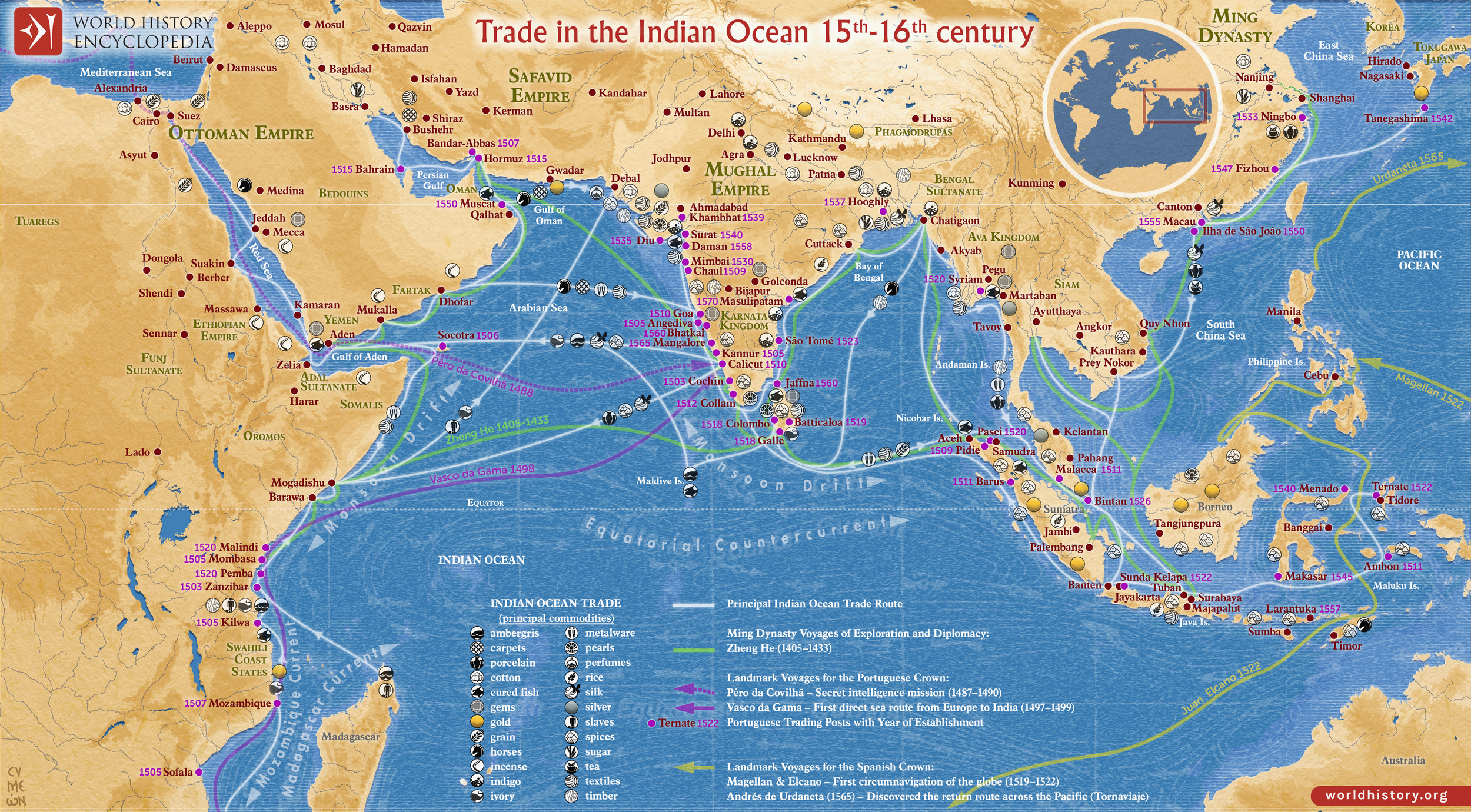
Map by Simeon Netchev March 2025 https://www.worldhistory.org/image/20178/map-of-the-trade-in-the-indian-ocean-15th-16th-cen/
The influx of precious metals and luxury goods from Southeast Asia fueled India's economy, empowering elite merchant guilds that functioned as private corporations with their own armies. These guilds acted as state bankers, funding infrastructure, naval expansion, and the construction of legendary Gupta and Chola temples. To protect these lucrative routes, the Chola Dynasty developed a superpower navy, turning the Bay of Bengal into a "Chola Lake" and establishing India as the central diplomatic and economic gravity of the pre-modern Asian world. This relationship was a true partnership of mutual enrichment; while India provided cultural blueprints, it gained vital resources from the Khmer Empire, including gold, aromatic resins, and sophisticated hydraulic engineering concepts that influenced Indian transshipment hubs.
Beyond material wealth, these routes served as a highway for faith. Buddhism and Hinduism spread not through sword or conquest, but through prestige and commerce. Buddhism often moved with the merchant classes, bringing literacy and artistic traditions to port cities. Simultaneously, Hinduism was adopted by Southeast Asian courts to bolster political authority through the concept of "God-Kingship." This cultural synthesis birthed some of humanity's greatest monuments, such as Borobudur and Angkor Wat. Indian architectural principles, such as the Vastu Shastra and the tiered Shikhara and Vimana styles, served as the foundational blueprints for these structures, which were then adapted by local builders into unique regional masterpieces.
The DARSHAN Asia photography project interprets this historical connection by photographing ancient sites across India and 12 SE Asian countries: Thailand, Cambodia, Myanmar, Vietnam, Japan, Indonesia, Sri Lanka, Bhutan, Nepal, China, Laos, and South Korea. This personal artistic exploration seeks to evoke the shared cultural symbols and temple architecture that still speak to the spiritual and aesthetic link between these regions. The journey will ultimately culminate in a published book, serving as a visual meditation on the deep-rooted ties based on the longstanding flow of trade and religion that continue to define the Asian landscape.